

Historical and Cultural Exploration
- Home
- Activities
- Historical and Cultural Exploration

The capital of Messinia, Kalamata, has a profound cultural and historical past. Kalamata has seen centuries of history that have shaped its identity, from its Byzantine and Venetian influences to its involvement in the Greek War of Independence. The city offers tourists the opportunity to explore archeological sites, museums, traditional districts, and cultural festivals as it combines its ancient past with modern vibrancy.
The city offers plenty of chances for historical and cultural exploration, whether you explore the Old Town, go to the Kalamata Castle, or learn about the local arts and crafts.
Drakopoulosdim – Own Work, CC By-SA 4.0, Image might be subject to copyright, Find Out on Commons Wikimedia
Kalamata’s Historical Landmarks
Kalamata Castle (Kastro)

Drakopoulosdim – Own Work, CC By-SA 4.0, Image might be subject to copyright, Find Out on Commons Wikimedia
The Kalamata Castle provides sweeping views of the city and the plains beyond on a hill on the northeastern outskirts of Kalamata. Initially constructed in the 13th century by the Crusaders of the Principality of Achaea, the castle was built upon the remnants of a Byzantine fortress that stood on the ancient acropolis of Pharae. Throughout its storied history, the castle has witnessed numerous occupations and reconstructions, reflecting the diverse cultural influences that have shaped the region. Today, visitors can explore its historic ruins, including the notable entrance gate, and enjoy panoramic views of Kalamata and its surroundings.
Why Visit
The city’s most iconic historical site, offering panoramic views of Kalamata and the Messinian Gulf.
Historical Significance
Built during the Byzantine era and expanded by the Franks and Venetians, the castle played a crucial defensive role in the region.
Location
Old Town of Kalamata

G Da – Panoramio, CC By-SA 3.0, Image might be subject to copyright, Find Out on Commons Wikimedia
The Old Town of Kalamata invites visitors to explore its rich tapestry of history and culture. This charming district is characterised by narrow alleys lined with neoclassical mansions, traditional stone-built churches, and squares. Notable landmarks include the Metropolitan Church of Ypapanti tou Sotiros, renowned for its impressive bell towers and silver domes, and the 23rd of March Square, commemorating the city’s pivotal role in the Greek War of Independence. As you wander through the Old Town, you’ll discover a blend of architectural styles reflecting the city’s Byzantine, Ottoman, and Venetian past, alongside museums and shops offering local products.
Why Visit
A charming area filled with neoclassical buildings, traditional shops, and historical sites.
What to Explore
Narrow streets, small Byzantine churches, and remnants of Venetian influence.
Cultural Experience
- Ideal for a walking tour to discover Kalamata’s historical atmosphere.
Location
Kalamata, 24100, Greece
Church of Agioi Apostoloi (Holy Apostles)

Maesi64 – Own Work, CC0 By 1.0, Image might be subject to copyright, Find Out on Commons Wikimedia
The Church of Agioi Apostoloi, located in the heart of Kalamata’s historic centre, is a testament to the city’s rich Byzantine heritage and pivotal role in Greece’s fight for independence. Dating back to the early 12th century, this revered monument showcases traditional Byzantine architecture. Notably, on March 23, 1821, it served as the gathering place where revolutionary leaders declared the commencement of the struggle against Ottoman rule, marking a significant moment in Messenia’s liberation. Today, the church remains a symbol of national pride and a cherished landmark for visitors and locals alike.
Why Visit
A historically significant church where the Greek War of Independence was first declared on March 23, 1821.
Historical Significance
A Byzantine-era church dating back to the 13th century, marking an important moment in Greek history.
Location
Kalamata, 24100, Greece
Museums & Cultural Institutions
Archaeological Museum of Messinia
The Archaeological Museum of Messenia offers a comprehensive journey through the region’s rich past. Established in 2009, the museum is housed in a reconstructed building that once served as the city’s Municipal Market, which was demolished after the 1986 earthquake due to severe damage. The museum’s permanent exhibition is organized into geographical units: Kalamata, Messini, Trifylia, and Pylia, presenting artifacts from the 5th millennium BC to 1453 AD. Visitors can explore a diverse collection of artifacts, including sculptures from ancient Koroni, tombstones, mosaic fragments, jewellery, and everyday items from the Mycenaean era. Through these curated displays, the museum provides valuable insights into the cultural evolution of Messenia, making it an essential destination for those interested in the region’s historical heritage.
Why Visit
A fascinating collection of artifacts from prehistoric times to the Byzantine era.
What to See
Exhibits include ancient pottery, mosaics, sculptures, and tools from various Messinian settlements.
Location
Agiou Ioannou 3, Kalamata 241 00, Greece
Kalamata Municipal Railway Park
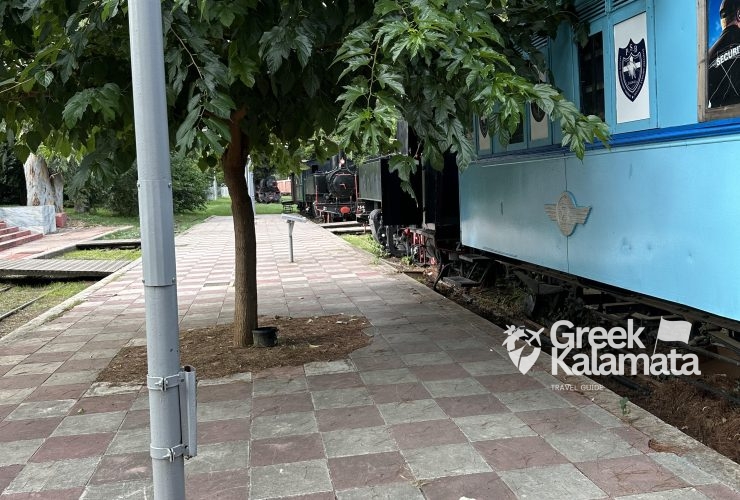
The Municipal Railway Park is Greece’s sole open-air museum dedicated to railway heritage. Established in 1986, the park occupies a sprawling 54-acre expanse that once housed the “Kalamata-Limin” station and adjacent areas formerly used for steam locomotive operations. Visitors can explore a curated collection of historic locomotives, carriages, and railway artifacts, offering a tangible glimpse into the nation’s transportation history. Beyond its historical exhibits, the park features verdant landscapes, walking paths, and recreational facilities, making it a cherished destination for history enthusiasts and families seeking relaxation.
Why Visit
Greece’s only open-air railway museum, showcasing historic train engines and carriages.
Historical Significance
Reflects the region’s industrial heritage and the importance of rail transport in Messinia.
Location
Praxitelous 2, Kalamata 241 00, Greece, Aristomenous 00, Kalamata 241 00, Greece
Historical and Folklore Museum of Kalamata

Housed in a neoclassical 19th-century building graciously donated by the Kyriakou family, the Historical and Folklore Museum of Kalamata offers a window into the city’s rich cultural tapestry. Established in 1973, the museum underwent restoration following the 1986 earthquakes and reopened in 2002. Its diverse exhibits chronicle Kalamata’s pre-industrial era, showcasing aspects of rural life, traditional crafts, and urban professions. Notable displays include artifacts from the 1821 Greek War of Independence, ecclesiastical items, and a dedicated section on the region’s pioneering role in Greek printing. Through these curated collections, visitors gain insight into Kalamata’s historical and cultural evolution and the broader Messinia region.
Why Visit
Greece’s only open-air railway museum, showcasing historic train engines and carriages.
Historical Significance
Reflects the region’s industrial heritage and the importance of rail transport in Messinia.
Location
Agiou Ioannou 12, Kalamata 241 00, Greece
Military Museum of Kalamata

Why Visit
A museum dedicated to Greece’s military history, particularly its role in the War of Independence and World War II.
What to See
Weapons, uniforms, and personal items from Greek soldiers, along with war-related exhibits.
Location
Μητροπολιτου Μελετίου 10, Kalamata 241 00, Greece
Ancient Sites Near Kalamata
Ancient Messene

George E. Koronaios – Own Work, CC By-SA 4.0, Image might be subject to copyright, Find Out on Commons Wikimedia
Ancient Messene stands as a testament to classical urban planning and resilience. Established in 369 BCE by the Theban general Epaminondas following Sparta’s defeat at the Battle of Leuctra, the city was designed as a fortified haven for the Messenians, who had long endured subjugation under Spartan rule. Today, the archaeological site is celebrated for its exceptional preservation, featuring structures such as a theatre, stadium, agora, temples, and robust fortifications. Remarkably, Ancient Messene was neither destroyed nor overbuilt in subsequent eras, allowing visitors to experience an authentic glimpse into ancient Greek urban life amidst the serene backdrop of Mount Ithome.
Why Visit
One of the best-preserved ancient cities in Greece, offering an impressive look into classical Greek and Roman history.
What to See
A massive ancient theater, a well-preserved stadium, temples, and fortifications.
Location
Messene (37°10.5′N 21°55.2′E / 37.1750°N 21.9200°E / 37.1750; 21.9200.)
Nestor’s Palace

Olecorre – Own Work, CC By-SA 3.0, Image might be subject to copyright, Find Out on Commons Wikimedia
Nestor’s Palace, located near modern-day Pylos in the southwestern Peloponnese, is a remarkable Mycenaean archaeological site. Believed to have been the administrative centre of the ancient kingdom of Pylos, the Palace is often associated with the legendary King Nestor, a prominent figure in Homer’s epics. Renowned as one of the best-preserved Mycenaean palaces in mainland Greece, it offers valuable insights into ancient Greek civilization. The site features a two-story structure with various rooms, including workshops, baths, and storage areas, reflecting the Palace’s role as a political and economic hub. Excavations have uncovered numerous artifacts, such as frescoes and Linear B tablets, enhancing our understanding of Mycenaean culture and administration. Today, Nestor’s Palace is a testament to ancient Greek heritage, attracting scholars and tourists eager to explore its historical significance.
Historical Significance
A Mycenaean-era palace linked to King Nestor, mentioned in Homer’s epics.
What to See
Ancient ruins, Linear B tablets, and beautiful sea views from the nearby hills.
Location
Ethniki Odos Kiparissias Pilou, Nestor 246 00, Greece